
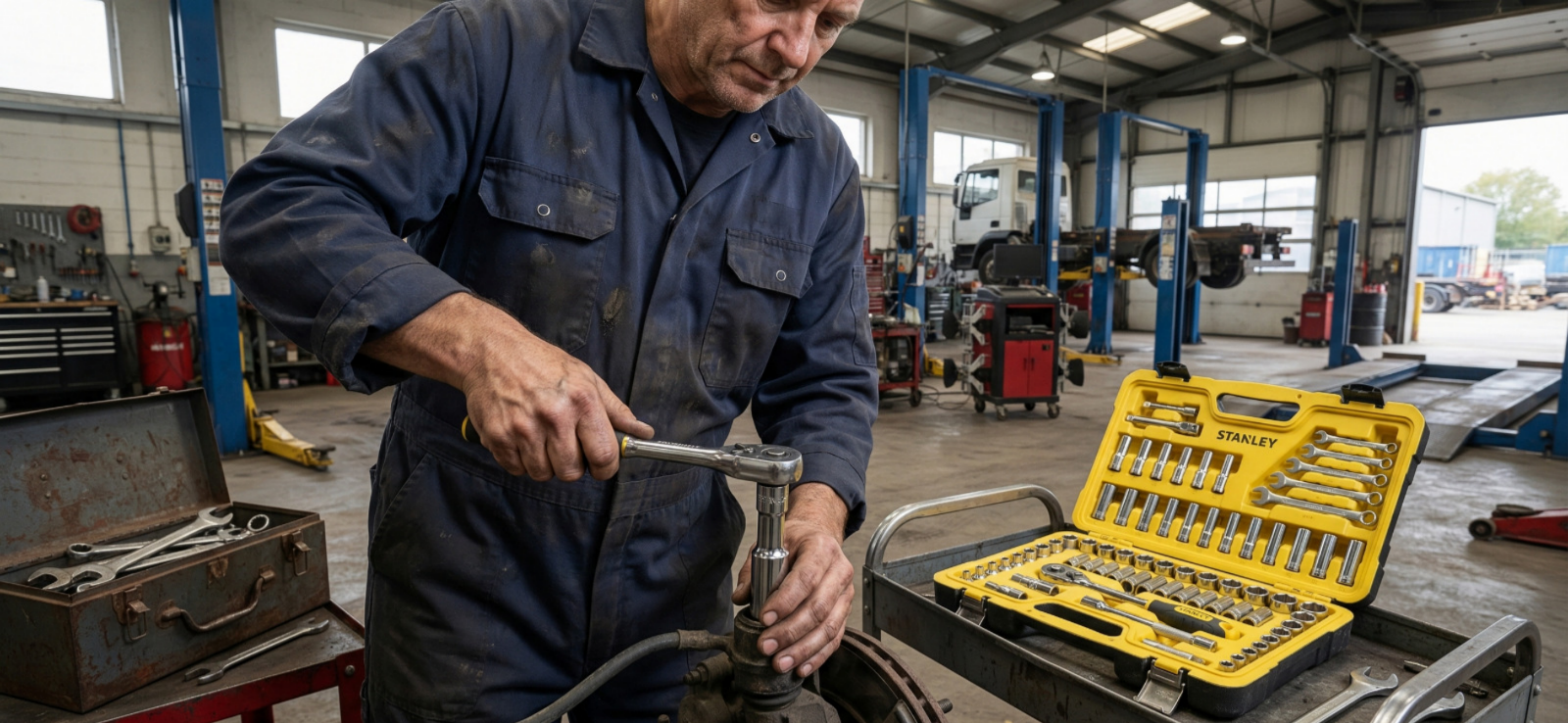
Every mechanic, technician, and workshop owner knows that a single broken spanner or stripped socket can stall a job right in the middle of a busy shift. Choosing between Stanley hand tools vs. generic garage tools is not just a purchasing decision—it directly affects repair speed, technician safety, and long-term workshop profitability. In high-volume automotive garages, industrial maintenance bays, and fleet service centers, relying on cheap, unbranded tools often costs far more over time than investing in dependable, precision-engineered equipment.
In this guide, we break down how Stanley hand tools compare to generic alternatives during daily repairs, where hidden costs hide, and how to build a reliable tool inventory for your workshop.
Why Tool Quality Matters in Daily Automotive and Industrial Repairs
Daily repair work puts constant torsional load, impact shock, and chemical exposure on hand tools. Whether a technician is loosening rusted suspension bolts on a commercial truck, torquing engine fasteners, or servicing passenger cars in a fast-paced bay, tool tolerances and metallurgy make a measurable difference.
Precision Fit Protects Fasteners and Components
Cheap sockets and wrenches often have loose internal tolerances or rough broaching. When a socket slips or rounds off a bolt head, a routine five-minute repair can turn into hours of drilling, extracting, or replacing expensive OEM fasteners. Quality tools grip flats cleanly and transfer torque evenly.
Ergonomics Reduce Fatigue Over Long Shifts
Mechanics often spend eight to ten hours a day turning ratchets, gripping pliers, and striking chisels. Well-balanced handles, contoured grips, and smooth ratchet mechanisms reduce hand strain and wrist fatigue, helping technicians stay accurate from the first job of the morning to the last vehicle in the evening.
Stanley Hand Tools vs. Generic Garage Tools: Key Differences
When evaluating Stanley hand tools vs. generic garage tools, look beyond the initial price tag on the invoice and examine how each performs under real shop-floor conditions.
| Feature / Factor | Stanley Hand Tools | Generic Garage Tools |
| Steel & Metallurgy | Controlled alloy/chrome-vanadium or high-grade tool steel with consistent heat treatment | Often inconsistent steel grades or soft heat treatment prone to bending or chipping |
| Dimensional Tolerance | Tighter machining tolerances for a snug fit on nuts, bolts, and fasteners | Looser fit, increasing the risk of slipping, rounding fasteners, and cam-out |
| Ratchet & Moving Parts | Smooth gear engagement, durable pawl mechanisms, and reliable reversing switches | Stiff action, skipping teeth under heavy load, or premature spring/pin failure |
| Surface Finish & Corrosion Resistance | Protective chrome or industrial finishes designed to resist shop oils, grease, and rust | Thin plating that peels, flakes, or rusts quickly in humid or oil-heavy bays |
| Replacement & Availability | Widely available across India with standardized part numbers and consistent batch quality | Hit-or-miss availability; matching an exact broken piece later can be difficult |
(Explore authentic Stanley hand tools for daily workshop repairs to standardize your service bay inventory.)
Hidden Costs of Generic Garage Tools in Busy Workshops
At first glance, generic garage tools look attractive because their upfront unit price is low. However, in active commercial garages, low-cost tools create recurring hidden expenses that quietly eat into profit margins.
1. Frequent Breakages and Constant Re-Buying
A wrench that cracks or a screwdriver tip that twists out of shape has to be replaced immediately. Buying the same basic tool two or three times a year quickly erases any upfront savings—and leaves bays short-handed while replacements are sourced.
2. Bay Downtime and Missed Turnaround Targets
Time is money in every repair center. If a technician has to stop mid-job to hunt for a replacement extension bar, pry bar, or socket because one failed under load, bay throughput drops and customer delivery timelines slip.
3. Higher Risk of Technician Injury
Slipped wrenches, shattered impact bits, or mushroomed striking heads can cause hand lacerations, knuckle scrapes, or flying metal fragments. Equipping technicians with dependable tools supports safer working habits across the shop floor.
Signs Your Current Workshop Tools Are Holding Back Productivity
- Technicians frequently double-wrench or slip cheater pipes over standard handles because ratchets feel weak.
- Fastener heads get rounded or damaged during routine disassembly.
- Corrosion or peeling chrome makes tools hard to clean or handle safely with oily hands.
- Missing or broken sizes force mechanics to borrow tools from neighboring bays.
Choosing the Right Hand Tools for Different Workshop Needs
Not every bay or job requires the exact same tool mix, so smart workshop managers match tool selection to actual workloads.
General Mechanical and Service Bays
For routine servicing, brake work, fluid changes, and suspension repairs, focus on core essentials:
- Combination spanners and ratcheting wrenches in commonly used metric and standard sizes
- Socket sets, extensions, and reliable ratchets for fast access in tight engine bays
- Pliers, screwdrivers, hex/Torx keys, and hammers for everyday assembly and disassembly
Heavy-Duty, Tyre, and Fleet Maintenance Bays
Commercial vehicles and heavy equipment demand extra leverage, durability, and complementary bay equipment. Alongside quality hand tools, workshops often pair manual tools with heavy-duty wheel alignment/tyre changer/lifts and bulk garage/tyre tools to handle large assemblies safely and efficiently.
(For complete bay setups, lifts, alignment systems, and workshop machinery, visit GarageEquipments.com to browse commercial garage equipment.)
Buying Bulk Garage & Tyre Tools for Multi-Bay Operations
When outfitting a new workshop or standardizing multiple service stations, ordering bulk garage/tyre tools helps keep every bay consistently stocked. Standardizing on one trusted brand across all tool trolleys simplifies inventory audits, speeds up onboarding for new technicians, and reduces mismatched tool clutter.
Tips to Maximize Tool Lifespan in Your Workshop
Even the best hand tools last longer when technicians follow simple care routines at the end of every shift:
- Use the Right Tool for the Job: Avoid using chrome hand sockets on high-torque pneumatic impact guns unless they are specifically rated as impact sockets.
- Wipe Down After Use: Clean away brake fluid, acids, heavy grease, and moisture so finishes stay intact and moving parts stay smooth.
- Keep Sets Organized: Store wrenches, sockets, and screwdrivers in dedicated trays or tool chest drawers so nothing gets lost under vehicles or left on floor mats.
- Inspect Regularly: Check ratchet heads, striking faces, and handles periodically and retire worn items before they fail mid-repair.
- Bureau of Indian Standards (BIS) – For relevant Indian standards on hand tools, industrial safety, and quality benchmarks.
Upgrade Your Workshop with Reliable Tools Built for Daily Demands Stop losing time and money to worn-out, unreliable tools during critical repairs. Browse genuine Stanley hand tools for dependable everyday performance, or plan a complete bulk garage/tyre tools order for your service bays.
👉 Shop Stanley Hand Tools at GarageShop24x7
Frequently Asked Questions
1. Why choose Stanley hand tools over generic garage tools for daily repairs?
Stanley hand tools offer tighter machining tolerances, more consistent steel quality and heat treatment, and better ergonomics than many generic tools. This reduces fastener rounding, lowers breakage rates, and keeps daily repair work moving smoothly.
2. Are generic garage tools ever a good option for workshops?
Generic tools are sometimes used for low-frequency, light-duty tasks or tight initial budgets, but frequent replacements, slower work, and damaged fasteners often make them more expensive over time in busy commercial workshops.
3. How do quality hand tools help prevent damaged nuts and bolts?
Precision-machined sockets and wrenches fit snugly against fastener flats rather than concentrating force on the corners. Better contact distributes torque evenly and reduces slipping or rounding on tight or slightly worn bolts.
4. How should a workshop organize bulk garage and tyre tools?
Assigning standardized tool sets to each bay or technician, using labeled drawers or shadow boards, and conducting quick end-of-week inventory checks helps prevent misplacement and keeps daily workflows efficient.
5. Can hand tools replace heavy equipment like lifts, tyre changers, or wheel aligners?
No. Hand tools are essential for assembly, disassembly, and precision mechanical work, while heavy equipment such as wheel alignment systems, tyre changers, and vehicle lifts handles heavy lifting, tyre mounting, and axle geometry safely and accurately.
